November 05, 2026
Creatine Gummies vs. Powder: What to Check Before You Choose
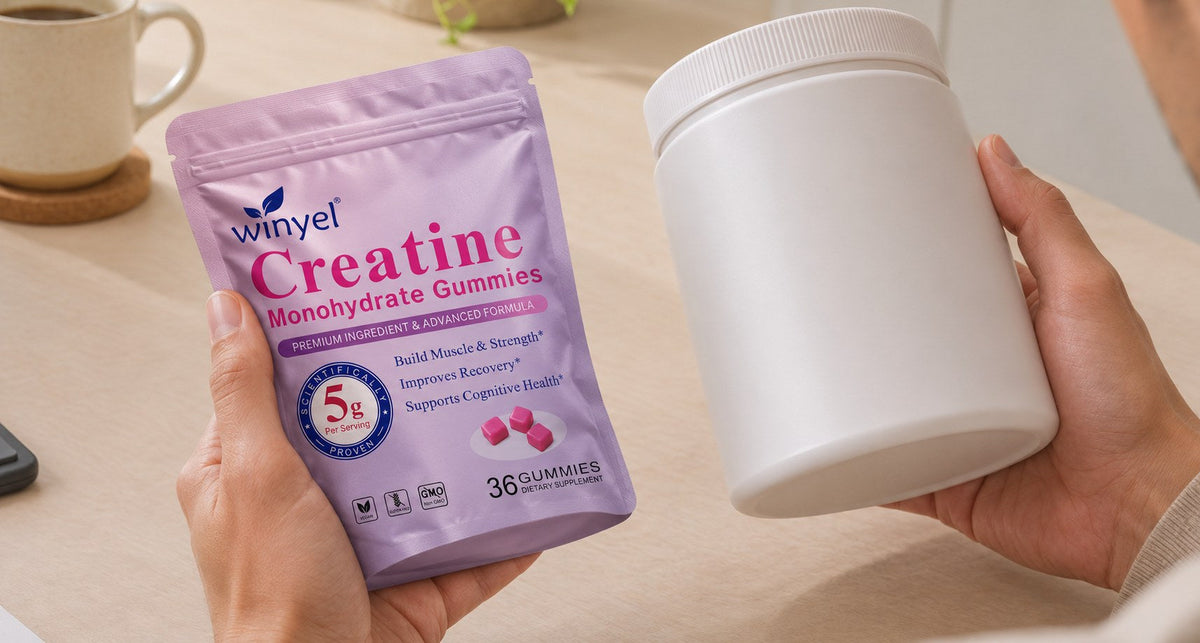
Choose around your training routine
If you’re buying creatine for the first time, start with the part of your routine you can picture repeating. Do you already mix a drink after training? Or would you rather carry a chewable option in your gym bag? The format should fit that routine, but you still need to compare complete servings, ingredients, price at the same creatine amount, and product documentation.
Which sounds more like your routine?
- You already mix a shake: compare a plain monohydrate powder first. Check its measured serving and whether it contains anything else.
- You prefer a chewable option: compare how many gummies make a complete serving and whether you want the added sweeteners.
- You are comparing prices: use the same labeled creatine amount for both formats, rather than the number of pieces in each container.
Creatine gummies vs powder at a glance
| What to compare | Gummies | Powder |
|---|---|---|
| Preparation and portability | No mixing; convenient to carry in their packaging | Requires measuring and mixing; individual packets can simplify travel |
| Complete serving | May require several gummies; check the count and creatine amount | Check the measured portion and creatine amount; scoop sizes vary |
| Additional ingredients | Usually includes sweeteners, flavors, and ingredients that create the texture | A plain product may contain only creatine monohydrate; flavored blends add ingredients |
| Research coverage | Limited studies of specific formulas | Much broader research history, particularly for monohydrate |
| Comparable value | Calculate cost for the same labeled creatine amount | Use the same calculation rather than comparing package prices alone |
| Quality documentation | Ask about finished-product potency, contaminants, and shelf-life support | Ask about potency and contaminants; powder format alone does not prove quality |
If you already mix a shake and prefer fewer ingredients, plain powder may suit you. If another mixed drink feels inconvenient and you enjoy chewing gummies, gummies may fit better. Neither preference establishes faster absorption or better results.
What is creatine used for?
Creatine is a substance your body makes and stores mainly in muscle. It helps replenish ATP, the energy source muscles use during brief, intense efforts.
According to the NIH Office of Dietary Supplements, creatine can support performance during repeated high-intensity activities, such as weightlifting and sprinting. Its usefulness is less established for steady endurance exercise. Individual responses vary.
Creatine monohydrate is the most widely studied form of the ingredient. “Gummy” and “powder” describe how a product delivers it. Evidence about monohydrate does not automatically establish the potency, stability, or effectiveness of every finished product containing it.
Read the whole serving, not just the package count
Start with three details: serving size, creatine per serving, and servings per container. The number of pieces on the front can mean something quite different from the number of complete servings.
A serving size tells you how the nutrition information is presented. Read the separate directions to learn how the manufacturer instructs you to use it.
For research context, NIH describes protocols using 3–5 grams daily after a loading phase, as well as protocols without loading. Those study methods are not instructions for a particular gummy. Do not multiply gummy servings to copy a loading protocol or exceed package directions.
Sugar-free does not mean carbohydrate-free
Gummies need ingredients that provide sweetness, structure, and texture. WINYEL’s displayed ingredient list includes maltitol syrup, isomalt, maltodextrin, xylitol, and pectin.
Maltitol, isomalt, and xylitol are sugar alcohols—a group of sweeteners. FDA guidance on sugar alcohols explains that sugar-free products can still contain carbohydrates and calories. Some people experience gas, bloating, or diarrhea from sugar alcohols; tolerance varies.
If you already know certain sweeteners bother you, check the ingredient list before buying. A single-ingredient powder gives you an option without those added sweeteners. Gummies are not automatically gentler on your stomach.
What does research tell us about creatine gummies?
Most creatine research has used powder. A 2026 randomized trial followed 32 female collegiate and professional beach volleyball athletes for 10 weeks. Seventeen received Create-brand gummies providing 5 grams of creatine monohydrate daily; 15 received no supplement or placebo.
Jumping and change-of-direction outcomes favored the gummy group. Lean body mass, skeletal muscle mass, and reaction time showed no significant between-group difference in change.
This small study had no powder comparison, and diet and training were not tightly controlled. Products were donated, and authors disclosed supplement-industry relationships. It offers evidence for one formula in one population—not proof that all gummies equal powder or that WINYEL’s formula produces those results.
A practical checklist before you buy
Use these checks for either format:
- Read the complete label. Find Supplement Facts, other ingredients, allergens, directions, warnings, storage instructions, and the expiration date. Ask for missing panels before purchasing.
- Check the complete serving. Confirm how many gummies or how much powder provides the stated creatine amount. Do not confuse total gummy weight or scoop weight with creatine content.
- Review added ingredients. Look for sweeteners, flavors, gelling agents, and other active ingredients that may affect your choice.
- Compare equal amounts. Divide package cost by total labeled grams of creatine monohydrate. Multiply that figure by the same comparison amount for both products. This is a price comparison, not a dosing recommendation.
- Ask for useful testing records. Request a finished-product certificate of analysis, ideally matching the lot you will receive. Check the laboratory, date, measured creatine content, and contaminants covered. Ask what supports potency through expiration.
- Verify certification claims. If a product claims NSF Certified for Sport certification, search the official NSF directory for the exact product and applicable lot information. A logo or another product’s listing is not enough.
A test report addresses the samples and measurements it covers. It does not demonstrate exercise benefits or replace a clinical trial.
Who should get individual advice first?
Creatine is generally well tolerated by healthy adults at studied amounts, although water-related weight gain can occur, according to NIH.
If you have kidney disease or another medical condition, take medication, are pregnant or breastfeeding, or are considering creatine for someone under 18, speak with a qualified healthcare professional first. Mayo Clinic highlights limited evidence in kidney disease, while NIH recommends professional guidance for performance supplements. Adult findings should not be assumed to establish suitability for every group.
Prefer a chewable format?
Review WINYEL’s creatine monohydrate gummies and current label to see whether the serving and ingredients fit your preferences. For missing package information or product-specific testing questions, contact WINYEL before purchasing.
Frequently asked questions
Are creatine gummies better than powder?
There is no universal winner. Gummies avoid mixing; plain powder can offer a shorter ingredient list. Compare the specific products, their complete servings, and their documentation.
Is one creatine gummy a full serving?
Not necessarily. Serving sizes vary. WINYEL’s displayed label lists three gummies per serving, so one gummy is not its complete labeled serving.
How can I tell which format offers better value?
Compare cost for the same labeled amount of creatine monohydrate. Package size, gummy count, and scoop count alone cannot make that comparison fairly.
Does sugar-free creatine contain zero carbohydrates?
No. Sugar-free products can contain other carbohydrates. Check total carbohydrate and calories on the facts panel rather than relying on the front-of-pack description.
What if a brand says its gummies are clinically proven?
Ask whether the research tested that exact finished formula. Ingredient research and a trial of another brand’s gummies do not establish that product’s results.
Sources & editorial transparency
This guide is published by WINYEL, which sells creatine gummies. Ingredient research and another brand’s trial are distinguished from the information declared on WINYEL’s product label. Product imagery is illustrative.
- NIH Office of Dietary Supplements: exercise and athletic performance — creatine evidence and research protocols.
- Pereira et al., 2026: creatine gummy trial — a small study of another brand’s formula.
- FDA: sugar alcohols — carbohydrate content and digestive tolerance.
- Mayo Clinic: creatine — safety considerations.